- Welcome to Probe Software Users Forum.

EPMA Software Designed By Users For Users
Recent posts
#21
EPMA (and SEM) Education and Training / Re: Presentations on EPMA
Last post by Probeman - October 13, 2026, 03:55:31 PMHere is the talk I gave Sunday called: "EPMA INACCURACY AND THERMOBAROMETRIC UNCERTAINTY" at GSA 2026 with co-authors Andrew Ducharme, Julien M. Allaz, Will Nachlas, Penny Wieser and Anette von der Handt.
See attached (remember to login to see attachments).
See attached (remember to login to see attachments).
#22
Probe Software User Forum / Re: Probe Software Forum Newsl...
Last post by John Donovan - October 06, 2026, 01:33:18 PMHi all,
Here is the 2026 summer newsletter that went out about a week ago:
Hi all,
The Probe Software EPMA user forum continues to be busy this summer (for a summer!) with 12 new topics, 175 new posts and 14 new members in July, August and September. The forum totals currently stand at 13,660 posts in 1564 topics by 947 members.
Heather Lowers suggested a formatting change to the statistically significant output format which we implemented:
https://smf.probesoftware.com/index.php?topic=40.msg14479#msg14479
Ben Buse is looking for sources of synthetic forsterite:
https://smf.probesoftware.com/index.php?topic=300.msg14477#msg14477
Probeman discusses oxide vs metal primary standards and peak shift/shape issues:
https://smf.probesoftware.com/index.php?topic=1831.msg14476#msg14476
Ben Buse asks and John Donovan responds to a question about EDS net intensities in Probe for EPMA and local versus remote storage/access of these intensities:
https://smf.probesoftware.com/index.php?topic=79.msg14475#msg14475
Ben Buse asks about the McEMPA Monte Carlo software and Probeman replies:
https://smf.probesoftware.com/index.php?topic=1046.msg14474#msg14474
John Donovan passes on a suggestion from Matt Taylor at Bruker for improving the reliability of connecting to the Bruker server:
https://smf.probesoftware.com/index.php?topic=123.msg14471#msg14471
Peng Jiang is having some beam stability issues with his new instrument and wonders what other labs experience and posts a poll:
https://smf.probesoftware.com/index.php?topic=1877.0
Much discussion from SEM Geologist, Probeman and Ben Buse.
Ben Buse asks about Paul Carpenter's Quantitative Mapping Explorer and when it might be available for outside usage, and John Donovan replies:
https://smf.probesoftware.com/index.php?topic=249.msg14488#msg14488
Ben Buse asks if anyone has had any luck finding a supplier for synthetic fayalite:
https://smf.probesoftware.com/index.php?topic=613.msg14486#msg14486
Ben Buse asks if SXES data can be quantified and JonF replies:
https://smf.probesoftware.com/index.php?topic=768.msg14484#msg14484
John Donovan reports that the issue with multiple windows popping up in the JEOL software when PFE is obtaining EDS net intensities using the MEC interface (iSP100/iHP200F) instruments) has been fixed:
https://smf.probesoftware.com/index.php?topic=79.msg14525#msg14525
Contact Probe Software for an updated MEC wrapper DLL.
Starting with this post and the next 5 or so posts are pdfs from the instructors at the EPMA software course at M&M 2026 this summer:
https://smf.probesoftware.com/index.php?topic=610.msg14458#msg14458
Lots and lots of useful information there. Remember or login to see attachments.
John Donovan mentions a handy tip when getting a "Too many tries loading analysis data from the JEOL MEC interface" error:
https://smf.probesoftware.com/index.php?topic=1288.msg14510#msg14510
Dawncruth asks if there is a string selection control in the Standard database and John Donovan replies:
https://smf.probesoftware.com/index.php?topic=71.msg14508#msg14508
Ben Buse reports some examples using the QGIS plug-in:
https://smf.probesoftware.com/index.php?topic=1707.msg14505#msg14505
Melissa Drignon asks about using a single standard calibration for multiple samples setups for different phases:
https://smf.probesoftware.com/index.php?topic=1878.0
and Scott Boroughs and John Donovan respond.
Several new EPMA positions open:
https://smf.probesoftware.com/index.php?topic=3.msg14517#msg14517
John Donovan posts about a tweak where the PFE now automatically skips assigning an MAN standard not only if the element is present but also if the standard is used as an interference assignment for that element:
https://smf.probesoftware.com/index.php?topic=4.msg14515#msg14515
Ben Buse asks if it would be possible to perform TDI corrections on EDS elements:
https://smf.probesoftware.com/index.php?topic=11.msg14531#msg14531
It is possible, but it would be lot of work. If one needs to perform TDI corrections on more than 5 elements, the solution is either the assigned TDI correction or splitting the sample into multiple setups and combining the samples (each with TDI) post acquisition:
https://smf.probesoftware.com/index.php?topic=11.msg14532#msg14532
and:
https://smf.probesoftware.com/index.php?topic=11.msg14534#msg14534
Wrigke asks if anyone has experience with standard materials from Periodic Today:
https://smf.probesoftware.com/index.php?topic=1880.msg14530#msg14530
Don Baker has an SXFive for sale:
https://smf.probesoftware.com/index.php?topic=1879.msg14529#msg14529
Allaz et al., published their paper on TDI corrections for beam sensitive samples:
https://smf.probesoftware.com/index.php?topic=11.msg14528#msg14528
John Donovan mentions that Probe for EPMA now utilizes direct instrument calls for Faraday cup control for status and insert/remove:
https://smf.probesoftware.com/index.php?topic=1360.msg14527#msg14527
This applies to the 8230/8530/iSP100/iHP200F instruments automatically once you are updated. Last year we added an option to utilize direct reads for beam current, but note that has to be set manually in the Probewin.ini file:
https://smf.probesoftware.com/index.php?topic=40.msg13725#msg13725
To investigate the quantification effects of metal versus oxide, Probeman acquired data on metals and oxides and shared them in a number of posts in the "Limits of EPMA Accuracy" topic. Start with this post with some accuracy testing on a JEOL instrument:
https://smf.probesoftware.com/index.php?topic=1831.msg14407#msg14407
Probeman also ran more tests on his Cameca SX100:
https://smf.probesoftware.com/index.php?topic=1831.msg14413#msg14413
The main point that this is using a pure oxide standard for oxide and silicates and a pure metal for sulfides and we still obtain ~1% relative accuracy. Question is this because there are peak shift and/or peak shape effects between the oxide and the metal?
Probeman posts results from K-411 and K-412 NIST glasses using pure oxide standards for Si, Mg and Fe:
https://smf.probesoftware.com/index.php?topic=1831.msg14433#msg14433
This is achieved with the log dead time correction, the DAM backscatter correction and improved PHA tuning:
https://smf.probesoftware.com/index.php?topic=1831.msg14448#msg14448
Andrew Ducharme and Probeman presented a poster "Breaking the 1% EPMA Accuracy Barrier" at M&M 2026:
https://smf.probesoftware.com/index.php?topic=1831.msg14457#msg14457
The pdf is attached to the post. Here is a post to see if the quant of oxides vs metals is purely a peak shift:
https://smf.probesoftware.com/index.php?topic=1831.msg14544#msg14544
Apparently, it is not just peak shift because we get essentially the same inaccuracy as using the same peak positions (though for sulfur in sulfides vs oxides it appears to be a pure peak shift.
Then here is a quant test running oxides vs metals using the integrated intensity feature in PFE:
https://smf.probesoftware.com/index.php?topic=1831.msg14545#msg14545
This yields ~1% accuracy! So it's definitely a peak shape issue! Interesting. The integrated intensity method in PFE is really designed for light element analysis when APF factors are not available, but it did the job here for Si, Mg and Fe nicely.
We announced our new EPMA Assistant:
https://smf.probesoftware.com/index.php?topic=233.msg14543#msg14543
Try it out and let us know what you think!
Ben Buse asks if JEOL SXES intensities can be quantified and Jon Fellowes responds:
https://smf.probesoftware.com/index.php?topic=768.msg14541#msg14541
Ben Buse asks if one can select a different map for drawing the polygon for pixel extraction in CalcImage and John Donovan responds:
https://smf.probesoftware.com/index.php?topic=55.msg14536#msg14536
Ben Buse asks about carbon evaporators and several people respond:
https://smf.probesoftware.com/index.php?topic=1554.msg14554#msg14554
Probeman posts a bit of wisdom regarding compressed gas cylinders:
https://smf.probesoftware.com/index.php?topic=1732.msg14553#msg14553
John Donovan posts a tip if you get a "too many tries" error when acquiring EDS data in PFE using the JEOL MEC interface:
https://smf.probesoftware.com/index.php?topic=1288.msg14510#msg14510
John Donovan mentions that he is giving a luncheon presentation on EPMA accuracy at GSA 2026:
https://smf.probesoftware.com/index.php?topic=1288.msg14510#msg14510
The EPMA Assistant is now available from the Help menu in PFE if you have Internet access:
https://smf.probesoftware.com/index.php?topic=40.msg14549#msg14549
Paula asks a question about Casino and Hendrix responds:
https://smf.probesoftware.com/index.php?topic=1859.0
Ben Buse asks about carbon thickness monitors:
https://smf.probesoftware.com/index.php?topic=1881.0
Probe for EPMA has JEOL driver updates for 8230/8530/iSP100/iHP200F instruments:
https://smf.probesoftware.com/index.php?topic=221.msg14560#msg14560
Melissa Drignon asks about low level radioactive samples in the EPMA and several people respond:
https://smf.probesoftware.com/index.php?topic=1861.0
The PictureSnap window in PFE can now handle larger images:
https://smf.probesoftware.com/index.php?topic=40.msg14568#msg14568
Regards,
The Probe Software Users Forum Team.
#23
Probe for EPMA / Re: Probe for EPMA Tips and Tr...
Last post by John Donovan - October 05, 2026, 03:22:56 PMHere's a cute trick by Anette von der Handt on how to prevent the JEOL stage backlash "jog" from being executed when performing a stage increment during a long acquisition:
https://smf.probesoftware.com/index.php?topic=464.msg2537#msg2537
"The direction of movement matters on JEOL stages in order to trigger (or avoid triggering) the backlash. So, adapting your stage increment values (shown in the link above) in PFE should fix this. The direction of best stage reproducibility in X-Y is moving towards 8.30 o clock. This is what I mean:

Give this a try by entering negative X and Y values in the increments (I assume that PFE can handle that) and see if it helps. At least until John can give you an updated PFE version. Even just dominantly going left and only very little in Y should be enough. This is also how I tend to set up traverses (well, going right to left instead of the other way at least) as I don't waste time on all the backlashes.
And in case you don't know, for setting the Z stage coordinates, you always want to finish with a clockwise move on the stage dial. I think it is up in Z, I can't test it right now and it is so second nature to me that I forgot."
https://smf.probesoftware.com/index.php?topic=464.msg2537#msg2537
"The direction of movement matters on JEOL stages in order to trigger (or avoid triggering) the backlash. So, adapting your stage increment values (shown in the link above) in PFE should fix this. The direction of best stage reproducibility in X-Y is moving towards 8.30 o clock. This is what I mean:
Give this a try by entering negative X and Y values in the increments (I assume that PFE can handle that) and see if it helps. At least until John can give you an updated PFE version. Even just dominantly going left and only very little in Y should be enough. This is also how I tend to set up traverses (well, going right to left instead of the other way at least) as I don't waste time on all the backlashes.
And in case you don't know, for setting the Z stage coordinates, you always want to finish with a clockwise move on the stage dial. I think it is up in Z, I can't test it right now and it is so second nature to me that I forgot."
#24
Discussion of General EPMA Issues / Re: Science in the News (pleas...
Last post by Probeman - October 04, 2026, 09:01:49 AMInteresting electron excitation:
https://interestingengineering.com/science/3d-light-field-reach-impossible-electron-states
https://interestingengineering.com/science/3d-light-field-reach-impossible-electron-states
#25
Discussion of General EPMA Issues / Re: EPMA Events (Meetings, Wor...
Last post by John Donovan - October 03, 2026, 09:36:31 AMReminder: Probe Software at GSA 2026 Denver:
Working with a number of experts in the field of microanalysis, we have recently developed and implemented some exciting new improvements in electron probe microanalysis (EPMA) accuracy. We think you will find these new methods useful in your own microprobe work.
We are excited to share these breakthroughs at a luncheon presentation entitled, "New Frontiers in EPMA Accuracy", during the GSA, Denver meeting in Mineral Hall B, on Tuesday October 13, 2026 at 12 noon to 1:30 pm by John Donovan.
If you will be joining us in Denver, or if you know someone who might be interested in coming, let us know and we'll see you for lunch!
#26
Probe for EPMA / Re: Tips and Tricks for PFE qu...
Last post by Probeman - October 01, 2026, 09:33:24 AMQuote from: Probeman on July 06, 2026, 02:42:33 PMTo ensure best EPMA accuracy in Probe for EPMA, based on recent testing:
https://smf.probesoftware.com/index.php?topic=1854.0
https://smf.probesoftware.com/index.php?topic=1831.0
https://smf.probesoftware.com/index.php?topic=1823.0
We now recommend setting the following defaults in your probewin.ini and SCALERS.DAT files.
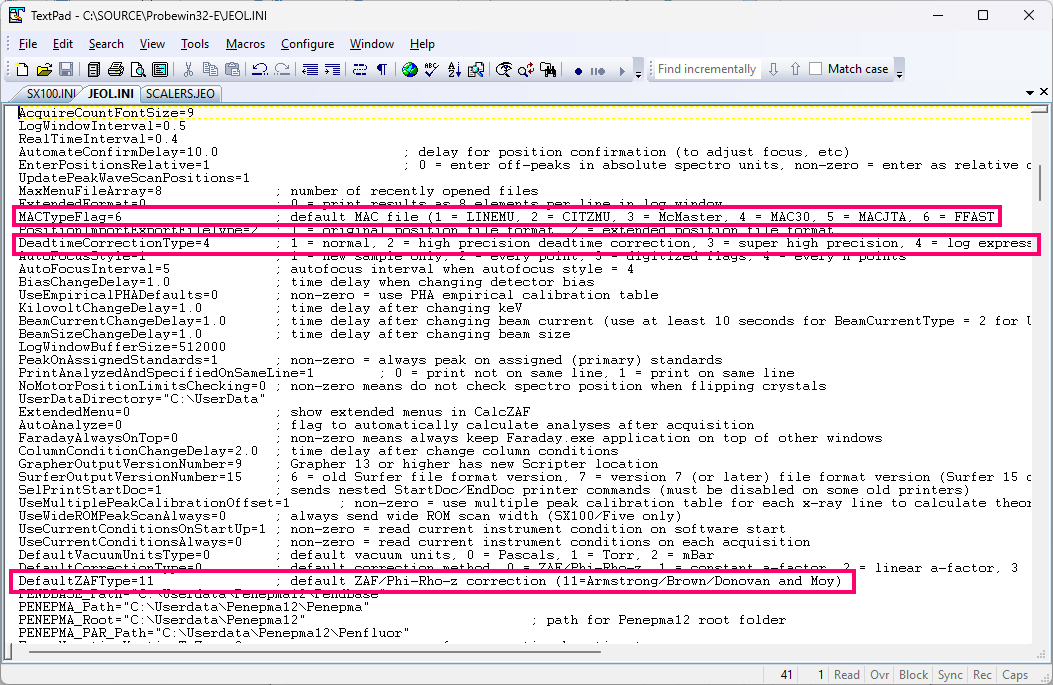
First edit the default MAC flag to 6 for the FFAST MACs (highest accuracy for the absorption correction):
https://smf.probesoftware.com/index.php?topic=1831.msg14340#msg14340
then edit the default dead time flag to 4 for the logarithmic dead time corrections (quantitative to 300 kcps!):
https://smf.probesoftware.com/index.php?topic=1466.msg13255#msg13255
and finally edit the default matrix correction flag to 11 for the Armstrong/Brown/Donovan and Moy matrix corrections (for improved backscatter correction accuracy):
https://smf.probesoftware.com/index.php?topic=1566.0
in your Probewin.ini file.
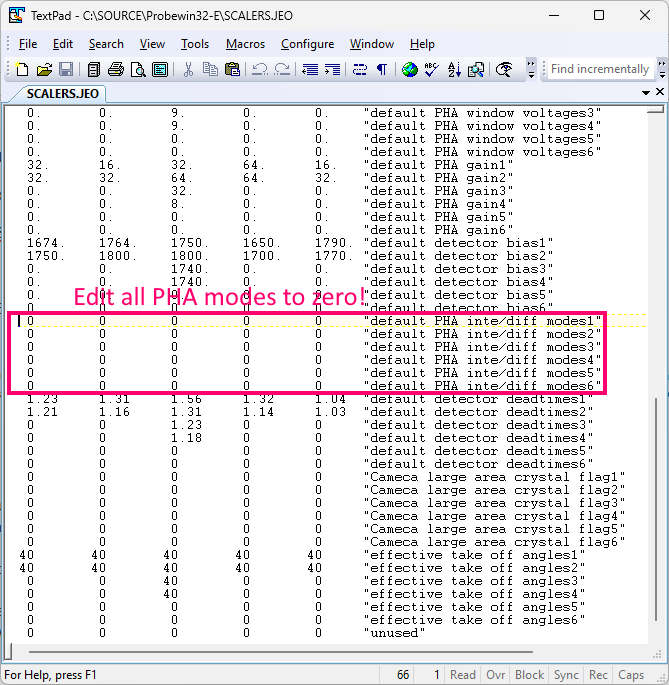
In your SCALERS.DAT file edit the PHA mode flags from non-zero to zero to make Integral PHA mode is your default (and correct for high order Bragg interferences using the quantitative interference corrections in Probe for EPMA):
https://smf.probesoftware.com/index.php?topic=1854.msg14402#msg14402
You will be amazed at the improvement in your EPMA accuracy.
Worth mentioning again.
#27
CalcImage / Re: Wish List For CalcImage
Last post by John Donovan - October 01, 2026, 07:15:15 AMQuote from: Paul Carpenter on September 29, 2026, 03:10:30 PMFirst of all, the QME tool is "Quantitative Microanalysis Explorer" and we use "Q-tool" for short since obviously people are not able to remember the name... Please use The Google to see references to publications to date.
Sorry about that! "Quantitative Microanalysis Explorer" is even better but it is a mouthful! I will call it "Q-tool" from now on.
#28
EPMA (and SEM) Standard Materials / Re: Periodic Today standards
Last post by Sander - September 30, 2026, 02:34:02 AMQuote from: wrigke on September 02, 2026, 12:16:48 PMDoes anyone have any experience with Periodic Today standards?
https://www.periodictoday.com/
Are they good quality?
Thanks!
Karen
Happy customer here. Highly reccommended.
#29
CalcImage / Re: Wish List For CalcImage
Last post by Paul Carpenter - September 29, 2026, 03:10:30 PMJohn and Ben,
First of all, the QME tool is "Quantitative Microanalysis Explorer" and we use "Q-tool" for short since obviously people are not able to remember the name ... Please use The Google to see references to publications to date.
I am currently working on moving the code from Matlab to Python. I am in the process of discussing with Ryan Ogliore and Brad Jolliff where we go with the tool. We favor open source but there are discussions needed and some issues with development under NASA and WashU funding, etc.
I would like to work on dovetailing with the CalcImage output as I have talked to John about several times, and have been working on code to make this happen.
The other aspect is Python coding using PyImageJ to interface with Fiji. That allows interrogation of quantitative map stacks and using the tools that are designed for image analysis.
The QME tool currently uses the web browser which is very nice for collaboration and I am looking at Python coding which allows the html scripts to be written.
Yes, currently it is a multistep process. What is really needed is the ability to take an EDS datacube and extract spectra, quantify, and present analytical data on demand. This could be done immediately after a map frame is acquired.
Stay tuned.
Paul
First of all, the QME tool is "Quantitative Microanalysis Explorer" and we use "Q-tool" for short since obviously people are not able to remember the name
... Please use The Google to see references to publications to date.I am currently working on moving the code from Matlab to Python. I am in the process of discussing with Ryan Ogliore and Brad Jolliff where we go with the tool. We favor open source but there are discussions needed and some issues with development under NASA and WashU funding, etc.
I would like to work on dovetailing with the CalcImage output as I have talked to John about several times, and have been working on code to make this happen.
The other aspect is Python coding using PyImageJ to interface with Fiji. That allows interrogation of quantitative map stacks and using the tools that are designed for image analysis.
The QME tool currently uses the web browser which is very nice for collaboration and I am looking at Python coding which allows the html scripts to be written.
Yes, currently it is a multistep process. What is really needed is the ability to take an EDS datacube and extract spectra, quantify, and present analytical data on demand. This could be done immediately after a map frame is acquired.
Stay tuned.
Paul
#30
EPMA (and SEM) Education and Training / Presentations on EPMA, Method ...
Last post by sckuehn - September 29, 2026, 10:06:48 AMForwarding on an October 22 webinar announcement about "best practices for reporting EPMA procedures, and community review." I'm not sure who they reached out to directly.
-----Original message-----
From: info
Sent: Monday, September 28 2026, 12:33 pm
To: info <info@astromat.org>
Subject: Invitation: Webinar on best practices for reporting EPMA procedures, and community review (Oct 22, 2026)
Dear colleagues,
You are receiving this email because you have been recommended by researchers as experts with EPMA (Electron Probe Micro-Analysis). We would like to invite you to a webinar on October 22, 2026 about a new effort to describe analytical procedures with EPMA in a consistent, comparable way. We are looking for expert reviewers, and we hope you'll consider joining us.
Who are we? This effort is led by the Astromaterials Data System team at the Lamont-Doherty Earth Observatory of Columbia University, which is the primary NASA-sponsored data archive for lab analytical data on extraterrestrial samples generated with a broad range of analytical techniques. It is endorsed by, and developed in collaboration with, members of the OneGeochemistry Initiative.
The problem. Analytical data increasingly sit in community databases, but the analytical procedures describing how they were produced mostly stay in publications or lab notebooks, in many different formats. Procedure reporting requirements differ among journals, databases, funding agencies, and scientific missions. As a result, it is hard to compare procedures across labs and studies, or to assess data quality based on procedure.
What we're doing. We are developing Technique-Aligned Procedure Profiles (TAPPs). Each TAPP is a structured list of procedure metadata that matters for one analytical technique frequently used in natural sample analysis. It uses a shared vocabulary and is reconciled against existing reporting standards, so that procedures can be compared directly and linked to the data in databases. TAPP for EPMA is among the first batch to be developed, together with XCT, ICP-MS, TEM, etc.
Why we need you. A TAPP is only as good as the practitioners who check it. We need experts who run the underlying instruments or use their data products to judge whether the profiles describe the technique correctly. That includes lab PIs and managers, technicians, research scientists, postdocs, and students. This review cannot be replaced by automation or done by the developers alone, and it is the crucial step toward TAPPs becoming community-recommended best practices.
What you get. Reviewers who contribute quality feedback will be invited to be co-authors on the TAPPs when we publish them.
Webinar details. The webinar will cover what an EPMA TAPP looks like and what review involves. We will run the same session twice on October 22, 2026 (for some time zones, the second session is on Oct 23) to accommodate time zones:
10 AM Eastern Time (14:00 UTC)
8 PM Eastern Time (00:00 UTC, Oct 23; 1 AM BST / 9 AM JST, Oct 23)
Please register using the links above for the session that works best for you. Feel free to forward this email to anyone who might be interested. If you have any questions, please reach out to info@astromat.org.
Best regards,
The Astromaterials Data System Team
astromat.org
info@astromat.org
Funded by the National Aeronautics and Space Administration (NASA)
Hosted by the Lamont-Doherty Earth Observatory of Columbia University